


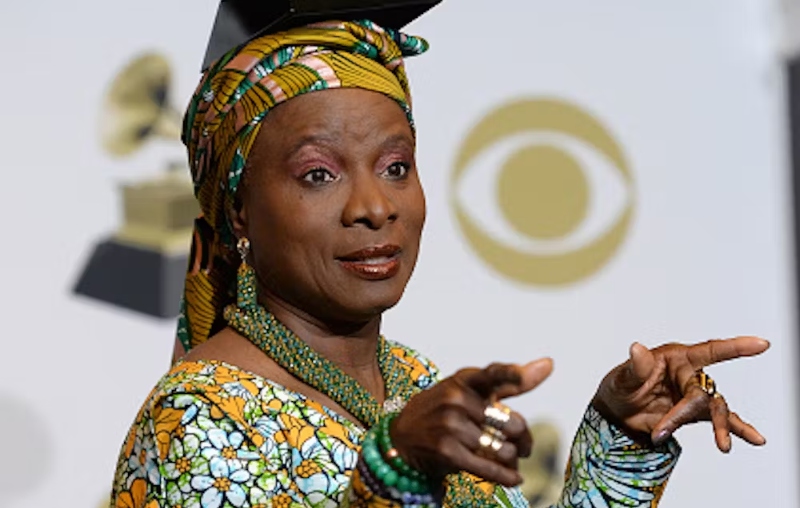
While African music dominates global charts and streams rack up billions, Angélique Kidjo sees a continent still divided by the invisible lines drawn by colonizers over a century ago. The Beninese icon, five-time Grammy winner and one of Africa’s most fearless cultural voices, is issuing a challenge. And it’s one that puts the continent’s biggest stars on notice: your success means nothing if it doesn’t unite us all.
Angélique Kidjo is calling on the continent’s music stars to use their global platform to forge a genuine Pan-African identity. In a passionate plea for unity, the global music ambassador declared that artists must succeed where government leaders have stalled, using music to build the cultural bridges that transcend colonial borders and linguistic divides.
“What the politicians cannot do, we should do,” Kidjo stated in an conversation with Netng, outlining a vision for a music industry that actively crosses the whole continent. Her concern is that the current Afrobeats boom, while globally successful, is too narrowly focused, primarily on Anglophone West Africa. She insists that for African music to remain relevant for generations to come, it must embrace the entire continent, from the Arabic-speaking north to the Portuguese and French-speaking regions. “We owe ourselves to cross the whole continent through music,” she declares.
Kidjo views Africa’s linguistic diversity not as a barrier, but as a “vast wealth” waiting to be tapped. She champions collaborations that feature languages like Hausa, Swahili, and Yoruba alongside French and English. “Our different languages are the vast wealth that we have,” she says. This is more than just a creative choice; it is a strategic move to build a unified cultural front. She points to her own work, like the multilingual “Chica de Favela,” as a working model.
Kidjo sees music as a diplomatic weapon that is capable of showing the world a more unified Africa. But that only works when artists put ego aside and aim for something bigger than the individual.

