By Adedayo Odulaja
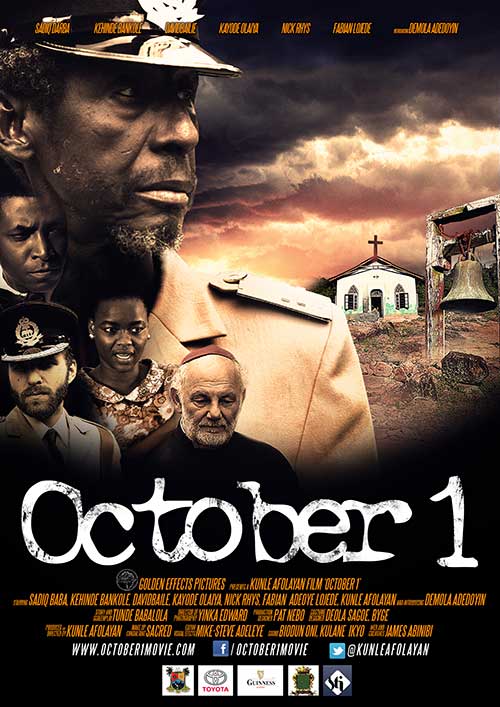
That there are not many contemporary producers and directors as regarded as Kunle Afolayan in the Nigerian movie industry, popular as Nollywood, is a fact.
Expectedly, anticipation began to mount immediately word got out that Afolayan, also son of late renowned film maker and actor, Ade Love, has a new film coming up.
And here, NET has a review to show that Afolayan has the course of excellence and didactic movie projects which he started and sustained with previous efforts including Irapada, Figurine and Phone Swap.
Steeped in the historical and as well, fictional accounts of Nigeria as a nation, October 1, features respected actors like Bimbo Manuel, Kanayo O. Kanayo, Sadiq Daba, Kehinde Bankole, Kayode Aderupoko, Ibrahim Chatta, Femi Adebayo, Kunle Afolayan, Deola Sagoe, Fabian Adeoye Lojede. Ifayemi Elebuibon, Abiodun Aleja. The predominantly-Nigerian cast is joined by Hollywood actors including David Bailie, Nick Rhys, Colin David Reese and Lawrence Stubbings.
Reflecting the last few days before Nigeria became independent of Britain as a sovereign nation, October 1 captures the deflated mood of a Yoruba town known as Akote while in part focusing on Inspector Dan Waziri (Sadiq Daba), a Nigeria Police officer sent by the colonial government to Akote in the advent of a series of murders.
The murders, with only young female members of the Akote population, represent ugly events that make the hearts of most people in Akote jump to their mouths even as independence for Nigeria beckons.
Waziri’s coming to Akote doesn’t stop the murders as another death is reported on September 7, 1960 when Bisi Olateru, a young woman in a relationship with one of the palace guards attached to Prince Aderopo (Demola Adedoyin), is killed. Like the two victims before her, Olateru’s body is mutilated after she is strangled.
This leaves the Inspector, roused from his sleep in the latest murder, to establish that they are dealing with a serial killer, just as an priest foretells earlier.
Not knowing that the killer is a high-ranking member of the community, Inspector Waziri declares a state of emergency as he soon faces an inquest from the colonial authorities.
In no time, another 17-year old lady joins the casualties, the fourth in two weeks, with all of them being virgins. And being proactive throughout, Waziri, who is not given to sentiments, orders the arrest of the Ifa priest (Ifayemi Elebuibon) who predicts earlier that there would be more killings.
But when Sergeant Afonja (Kayode Aderupoko), a son of the soil and Waziri’s deputy, says arresting the Ifa priest is a taboo he cannot dare to effect, Waziri suspends him, determined to get to the root of the murders and appoints a young but educated officer, Corporal Omolodun (Fabian Adeoye Lojede) in his place.
The suspension of Afonja leads to the desertion of the force by the rank and file but Waziri, seemingly unperturbed, presses on. But with the image of Sergeant Afonja looming large in the town and affecting the morale of men ready to work even, Waziri moves to reinstate the suspended sergeant. While at Afonja’s house, where Waziri has gone to announce Afonja’s reinstatement, a message comes to both that another girl is missing.
This time, it is Chidinma, the daughter of a local hunter known as Okafor (Kanayo O. Kanayo). And it is the search for the missing girl, found murdered thereafter, that leads to the excellent resolution of the conflict thrown up in the flick.
As a film, October 1 has everything, ranging from great pictures to flawless acting, moving soundtrack to bites of uncertainty and spiced by well-cultivated grounds of humorous instances.
One of the comic parts comes to the fore when Afonja’s wife curses Waziri who has come to visit his erstwhile deputy in Yoruba while her husband says she means the meal is very good.
Another piece of humour is infused in the scene where Ropo comes to visit Miss Tawa (Kehinde Bankole) with Mr Olaitan (Abiodun Aleja) standing rooted to a spot and infuriated at the sight of the two gisting.
There is yet another in the scene in which Corporal Omolodun interprets between Waziri and the illiterate Ifa priest. Told to put it to older man that he is concealing the identity of the killer, Omolodun rather thanks the man.
Using a deft interplay of events, the film deftly touches on the issues of unnecessary ethnic tensions among Nigeria’s ethnic groups, the wicked, selfish and politically-directed decisions of colonial masters while also putting across the issue of paedophile priests on the front burner.
Shot on locations in Lagos, Ilara-Mokin and Akure in Ondo State, the film is no doubt a stretch of Afolayan’s impressive offerings.