


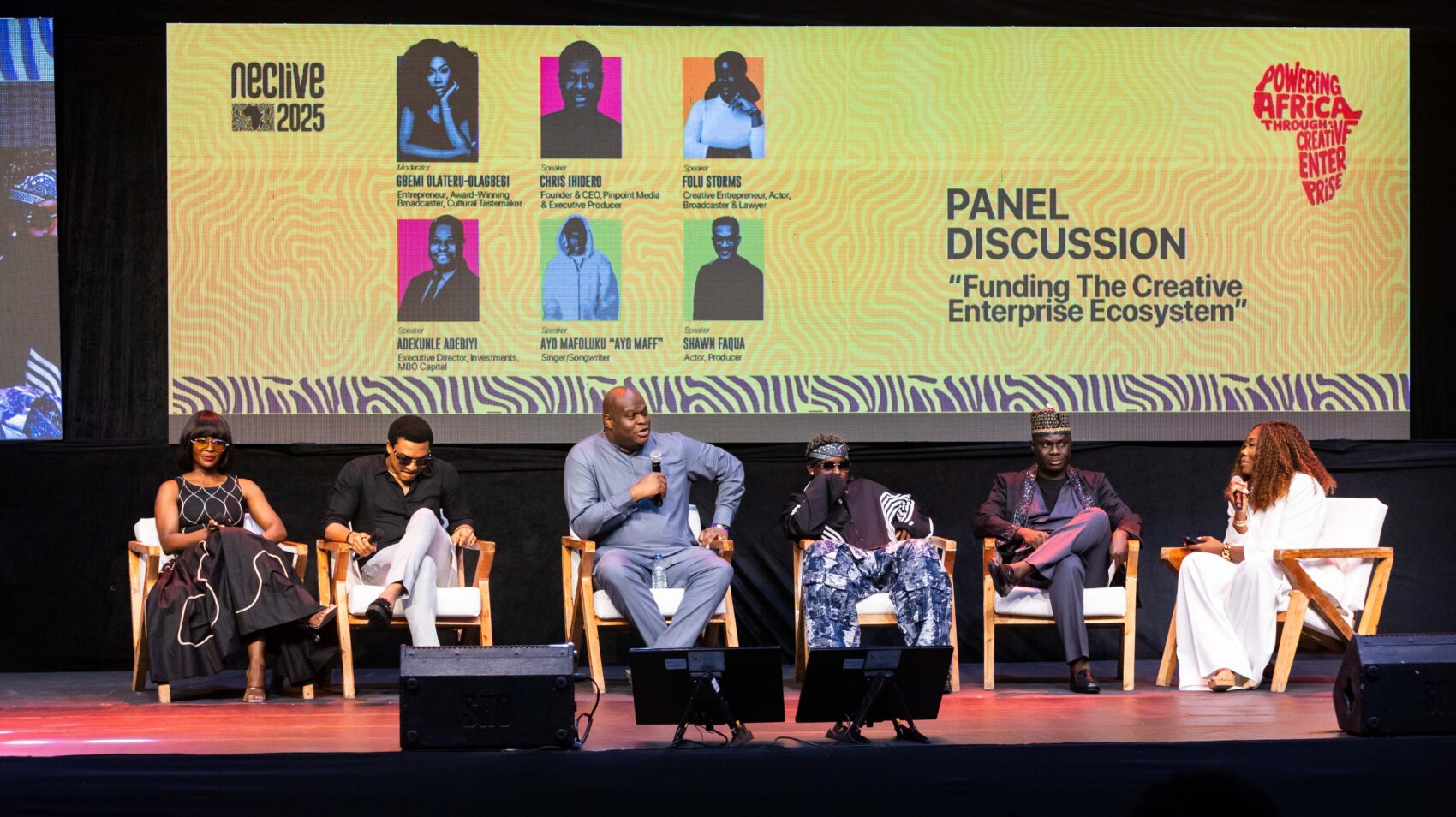
The narrative that financing remains a primary obstacle for Nigeria’s creative sector faced direct challenge at NECLive 2025, as investment executives revealed they’ve deployed over $6 million across 35 films while emphasising that lack of business structure—not capital availability—represents the true barrier to creative funding.
During the panel discussion on “Funding the Creative Enterprise Ecosystem,” moderated by Gbemi Olateru-Olagbegi, representatives from MBO Capital, legal experts, and filmmakers engaged in frank dialogue about the intersection of creativity and commerce, using the upcoming film “Aloma” as a case study for successful collaboration.
Adekunle Adebiyi of MBO Capital delivered the session’s most provocative assertion: “I actually don’t think financing the creative space is a challenge anymore.” His firm has financed 35 films, with 25 currently streaming on Amazon Prime or Netflix, and three theatrical releases including Chris Ihidero’s “Aloma,” slated for release in 2026 alongside “Three Cold Dishes” and “Stitches.”
Adebiyi outlined non-negotiable requirements for investment consideration: corporate structure, tax compliance, filed audited accounts, and professional financial and legal advisors. “We need to see that you are organized,” he stated. “Creative people need to think about themselves as business people as well.”
He rejected suggestions that financing models should adapt to creative dreams rather than business realities. “That’s not going to happen,” he declared, though acknowledging that creatives need not possess deep business expertise themselves. “If you are a creative and you know you are a creative, make sure you have a finance person or an accountant, and make sure you have a lawyer as well.”
The panel’s filmmaker participants demonstrated this principle in practice. Chris Ihidero of Pinpoint Media described his eight-year journey bringing “Aloma” from 2016 concept to 2025 completion, including rejection from a streaming platform that demanded he convert the story into a telenovela. His eventual partnership with MBO Capital involved navigating rigorous legal processes and accepting part-debt, part-equity financing that left him owning a smaller portion of the project.
“When funding meets creativity in a convenient and comfortable environment, this can be the result,” Ihidero explained, noting his decision to take post-production to South Africa to achieve international quality standards. The production completed 118 script pages in 25 shooting days during June-July, maintaining quality without compromise.
Folu Storms, who also acts in “Aloma,” emphasised the critical role of documentation in protecting creative vision when investors enter negotiations. “Stop having just phone conversations,” she advised. “Whatever you discuss over the phone, follow up with an email at minimum. What has been written down will be considered if you have to go the legal route.”
The Red Circle star addressed creatives’ resistance to legal involvement, noting the perception that lawyers make situations “too intense.” She countered that early legal engagement prevents dangerous exposure. “While it seems excessive to have a lawyer from the beginning, have a lawyer earlier on,” she stated.
The streaming platforms’ reduced Nigerian investment—referenced as when “the streamers left”—created opportunities rather than obstacles, according to Adebiyi. Previously, MBO Capital provided debt financing against Amazon or Netflix contracts with minimal risk. The platforms’ departure forced model evolution toward part-debt, part-equity structures. “If you want to hammer, I want to hammer with you. It’s essentially a marriage,” he explained.
Actor Shawn Faqua stressed that protecting intellectual property doesn’t signal distrust. “We must get comfortable with the business part of creative work,” he said, noting the increased availability of specialised entertainment lawyers. He praised “Aloma’s” script quality and collaborative environment, emphasising that filmmaking requires complete team cohesion.
Musician Ayo Maff, making his acting debut in “Aloma,” demonstrated professional reliability that defied stereotypes. Ihidero initially resisted casting an artiste, fearing irresponsibility and availability issues. Maff consistently arrived early, remained through 12-hour days despite minimal actual camera time, and his management team proactively addressed scheduling conflicts.
Folu Storms concluded with fundamental advice: “Creatives need to understand that you are an entrepreneur. You are a business. It is your responsibility to learn how all aspects work so you know who to hire.” She emphasised understanding enough about accounting and legal functions to build appropriate structures, accepting that failure will occur, but should happen quickly to enable forward progress.

