


By Oluwole Leigh
Molues are large capacity vehicles that moved people around the city of Lagos for many years. Most of the Molues were originally 911 Mercedes Benz Trucks that had been converted into Mass Transit vehicles. It seemed as if the head of a Mercedes truck had been joined to the body of another vehicle. The origin of the word ‘Molue’ is debatable. A school of thought believes that ‘Molue’ originated from the word ‘Maul’. As strange as this account sounds the fact that we have heard stranger origins of words in our local language makes it plausible. E.g.: A colonialist was said to have visited an area of Ibadan and remarked that the area was ‘Too Dirty’. Many years after, that area’s name changed to ‘Kudeti’. Thus, it is possible that the word ‘Maul’ transformed to ‘Molue’. These vehicles bring a new definition to the word ‘rickety’. As uncomfortable as the Molues were, the masses loved them. The introduction of BRT (Bus Rapid Transit) by Lagos State Government did not kill the love for Molues. There were times when the more comfortable BRT buses charged the same fares as Molues. This gesture was not enough to take away the demand for Molues. Somewhere along the line, the government wielded a big stick and banned them.
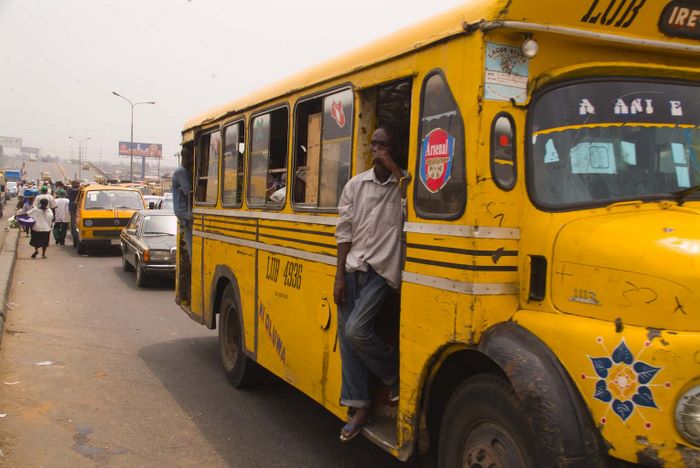
The following experience is a combination of various experiences presented as a single experience
Gaining entrance into a Molue requires a lot of skill depending on the location. Bus stops such as Obalende and CMS are places where you queue for Molues. You see a long queue of people that stretches back a few metres. Everyone lines up and pays their transport fare before entering the vehicle. The fact that transport fare is paid before entry makes the journey a little peaceful and enjoyable. Once all the seats have been taken up, the 2nd Conductor signals to the other one that ‘sitting is finished’. The next set of passengers to be admitted is going to be standing. The fare for standing is cheaper than that for sitting. Another set of passengers are brought into the bus for to stand. This scenario is described by Fela Anikulapo Kuti as ‘44 sitting, 99 standing’. The conductors usually have no upper limit for the number of passengers in the vehicle. The Upper limit is reached when passengers begin to complain about the lack of oxygen in the Vehicle.
Immediately, the Molue got filled up, the driver emerged from thin air and got into the front of the vehicle. Getting the vehicle started took a few minutes. The conductor turned mechanic had to open up the hood and pour a mixture of what looked like Oil and Water to get the engines firing. The vehicle roared into life and we took off. After a Molue takes off , you get about a minute of peace and quiet before the next drama happens.
The next drama is usually one of the following – a drug peddler, a preacher or a book seller. The drug peddler clears his voice and begins to talk about the potency of his medicine. The ailments he is claiming to cure are usually sexual in nature. He tells passengers that Premature ejaculation and impotence cannot stand the sight of his Medicine. He passes a couple of them round for passengers to examine. The second stage of this exercise is when he brings out what he calls’ Gbogbo Ise’. ‘Gbogbo Ise’ is a magical drug that cures headache, typhoid fever, malaria, hypertension, weakness and back aches .This is the wonder drug that most have been waiting for. He again sends samples of the drug around and passengers start buying. The drug peddler is often a lesson in Public Health advocacy. He tells passengers that he understands their pain and their frustrations. He makes them laugh and digs into their emotions. By the time he is done with them, they’ve parted away with their money in exchange for some piece of chalk
Once we got on the bridge, the Molue driver found himself on the extreme left of the lanes. Third Mainland Bridge has 4 lanes in most places except at the middle part where traffic turns off and joins in. Side mirrors are a luxury which many public transport vehicles in Lagos cannot afford. Most have been broken off in collisions or have been transformed for home use. In this case, the conductor had become the side mirror. The method of communication between the driver and the conductor is often a combination of loud shouts and sounds made by hitting the body of the vehicle. We were on Lane 1 when the driver shouted ‘Bawo’. The conductor replied with a hit and a shout- ‘Wole’. The driver swerved to Lane 2 and the process repeated itself. By the time we moved to Lane 4, everybody sat up to watch the driver’s actions. Once again, the driver shouted ‘Bawo’. The passengers did not wait for the conductor respond before shouting on the driver. Curse words were thrown at him, his dead ancestors and his unborn grandchildren. After a while, all went calm. We got to the next stop which was ‘Iyana Oworo’ and some passengers got off. The driver got out of the vehicle to pee into the nearby bush. At this time, most people realised he probably had some local brew before we set off from Obalende. The next interruption was the voice of a Preacher.
On Molue buses, there are usually 2 types of Preachers. The difference is often a combination of the church of the Preacher and the part of the country the preacher is from. Bus preachers from the South West are usually interested in telling you about Hellfire and damnation. The message usually comes out rough and raw. The listeners are often caught between a place of fear and lack of interest. After the preaching is done, such preachers would pass out tracts for passengers to read. Preachers from the South East are usually of the Pentecostal variant. They start with sweet and melodious music that calms your frayed nerves after a hard day’s work. Most people who are not ready to have their thoughts interrupted often find themselves joining in the singing and clapping after a while. Once the singing is done, the preacher regales you with testimonies of what God has done in the lives of people around him. Miracles and blessings are promised to the listeners if they listen to him. At the end of the sermon, an envelope is passed around the bus for passengers to ‘contribute to the ministry’.
We went on and then we got to Oshodi. Oshodi Oke as it is popularly called is a major terminus for buses going to different parts of Lagos. These buses are generally not allowed to park on the bridge. Thus they have to perform the task of offloading and loading passengers while they are in motion. A new set of passengers got in at Oshodi. I stayed on the Molue because it was still headed in my direction. The difference between the organization displayed at Obalende and the chaos at Oshodi becomes clear the moment the bus takes off. The conductor starts shouting aloud, – ‘Cele, first bus stop, Cele, first bus stop, Iyana Isolo ma wole’. This translates to ‘We are not stopping till we get to Cele bustop’. The Molue does not stop along the way because the conductors need enough time to go through the crowd and collect the fares. I often wondered how conductors were able to differentiate between passengers who entered at Oshodi and those who entered at Obalende. As the bus sped away from Oshodi, some were lucky enough to hop in while others were not as lucky.
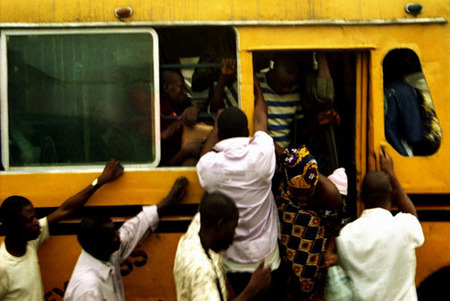
Jumping into a moving vehicle is no mean feat. The best option is to either be among the first to enter or the last to enter. The problem with aiming for the last position is that you may not get in at all. You also do not want to get cut up in the crush. The crush usually happens after the first set of passengers get in and every other person begins the struggle of getting in. The crush is often an avenue for pickpockets to make away with your possessions. My first experience with the crush had me suspended in mid-air for about 3 minutes. I was neither getting into the bus nor falling back. Opposing forces seemed to have balanced out and I was levitating.
Some commotion occurred and we heard a slap. A woman had slapped the man behind her. Whenever the driver pressed the brakes, bodies surged forward. The surge often resulted in the coming together of bodies. It was better to hit another body than to hit the sharp edge of a seat. In this case, it seemed as if the man was enjoying the sudden friction between his body and certain aspects of the female anatomy in front of him. He was caught and summarily dealt with by the woman in question. The man shamefully tucked his erect member in between his legs. The conductor shouted ‘Bring out your change to avoid joining’.
Joining happens when a couple of passengers are given a lump sum of change e.g There are 5 passengers who are supposed to collect N20 change each. The conductor waits till the last moment and hands all of them N100. The responsibility for getting the change is outsourced to the passengers. Since the Molue conductor has a lot of issues demanding for his attention, you do not want him to owe you any change. In the event that he does, he will issue you a token. The token is usually a particular card from a deck of cards that are with him. He is the only one that knows how much the token represents. You are supposed to hand him the joker before you get off so he can redeem his debt. If you think you are smart enough to come into the Molue with your designated cards, you will be disappointed. He marks/ signs them in specific places and changes them every day.
I gave the conductor the exact fare in order to avoid ‘joining’ or receiving an ‘Ace of Spades’. The driver slowed down as we got to Cele bus stop and I hopped off. I looked back and saw a couple of passengers who had been ‘joined’ together arguing with each other. The Molue drove off and went out of sight.


1 comment
Wow! Wow!! Wow! I love this article. I grew up in Lagos so I know about all the writer of this article is saying. Molue, a very fun place to be.