‘Do not be deceived by appearances; everything turns left soon after’, that should be the opening line of every review of the Blood Sisters.
In the past few months, multiple reports of cases of domestic violence have evoked outrage across Nigeria. The death of rising gospel singer Osinachi Nwachukwu, allegedly abused by her husband for years until she passed away in April, 2022, further fuelled anger on social media.
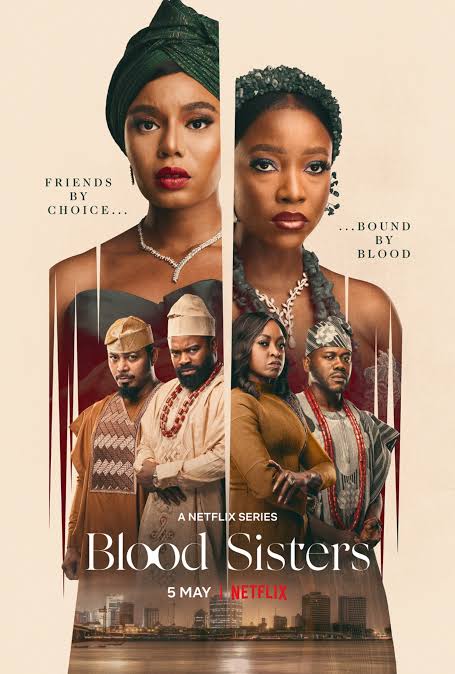
Blood Sisters, the thriller series by Mo Abudu, released on Netflix on May 5, 2022, comes at a timely moment where people can see the direct consequences of domestic violence and how a minor case of ‘it’s just a slap’ can lead to a lifetime of pain, regret, crime and restlessness.
Through her filmmaking company EbonyLife Studios, in partnership with streaming service Netflix, Mo Abudu continues to deliver movies that address pertinent social issues like domestic violence, friendships, family rivalry, dysfunctional families, love, and more while taking the Nigerian society into cognisance.
The thriller series produced by Biyi Bandele and Kenneth Gyang is a four-part series with seasoned actors like Ramsey Noah, Nancy Isime, Kate Henshaw, Daniel Etim-Effiong, Wale Ojo, Ini Dima-Okojie, Kehinde Bankole, Deyemi Okanlawon, Gabriel Afolayan, and more.
Blood Sisters set in Lagos, Nigeria’s commercial capital, is centred around Sarah Duru (Ini Dima-Okojie) and Kemi (Nancy Isime), who played best friends. On Sarah’s engagement day, the friends became fugitives after Kemi pulled the trigger on Kola Ademola (Deyemi Okanlawon), Sarah’s fiance while defending Sarah against Kola’s physical abuse.
Kola Ademola, an affluent but ruthless businessman, died from the gunshot, and both friends found a way to dismember the body and bury him shabbily. The situation goes south as the police find Kola’s body buried in a shallow grave, and all signs point to the best friends for murdering Madam Uduak’s favourite and most treasured son.
Madam Uduak (Kate Henshaw) is Kola Ademola’s mother and the backbone of the Ademola family. She is ruthless to her children and even more brutal to outsiders. At the beginning of the series, she clearly stated that she did not like Sarah because of her poor background, and she is ready to deal with Sarah and Kemi in every way possible for murdering her most beloved son of her three children.
The movie ends in a cliffhanger, with Madam Uduak’s daughter, Timeyin (Genoveva Umeh), pointing a gun to her mother’s head for destroying their family.
The four-episode series explores many themes, including highlighting the typical behaviour of abusers and victims, as in the case of Kola and Sarah. It explores family rivalry regarding how Femi Ademola (Gabriel Afolayan) and his wife Yinka (Kehinde Balogun) sent an assassin to kill his brother because they were not in charge of the family business. It also explores love and its consequences with Kenny (Ibrahim Suleiman), who eventually died because he was intent on helping the love of his life, Sarah. Another critical theme it explores is friendship; despite their fights and issues, Sarah and Kemi never blamed each other for their predicaments. They just found a way to press on and solve their situation while solely trusting each other.
The acting was not a missing part of the movie; almost everyone bodied their roles and were superb at it. Genoveva Umeh deserves a special shout out for her role as the ticking bomb Timeyin in the Ademola family.
The cinematography is also great. Every part of Nigeria featured in the movie was captured in their essence with very crisp imagery, which was satisfying. From highbrow areas like Lekki to the Makoko slum, everywhere was well represented. They gave us the Nigerian experience in four episodes.
Another distinctive aspect of the movie is the costume design. Yolanda Okereke deserves an accolade and more for the work and dedication she imputed to give the character an outlook that represents their characters perfectly. Every character looked graceful and looked their part in every scene. Surprisingly, the action and stunt aspects of the movie were not cringey, they did not seem unnatural or out of place, they were just perfect, and everyone did what had to be done.
One thing that is appreciated in this movie is the use of Nigerian culture to tell the stories. The dialogue, the language and the mannerism of the film were tailored towards the use of Nigerian languages; the actors comfortably oscillated between speaking Igbo, Pidgin, and English. It was delightful to watch.
However, the movie is not without flaws, as some casts seemed particularly unnecessary in the story’s development, which is always a problem with star-studded films. Although they managed to pull it off to a great extent, some of these characters did not just suit their roles or were outrightly unnecessary to the development of the plot.
As much as the movie was captivating and exciting at some point, the writer was almost obsessed with proving that the girls were innocent. Some parts of the film started to seem unbelievable and outrageous, especially when Kola’s best friend (Daniel Etim-Effiong) investigated if his ‘childhood friend’ indeed abused all the women in his life. The story seemed unrealistic at that point.
Overall, it was a good movie and a significant improvement from EbonyLife’s previous film – ‘Chief Daddy 2.’
Rating: 8/10