


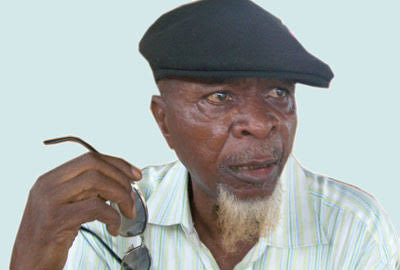
Besides the diminutive nonagerian’s energetic strides, greyish goatee and usual stern look, Olumo has, in a career spanning over 50 decades, earned a reputation as one of Nollywood’s most feared characters. Indeed, he has proudly credited himself as the ‘first bad man’ of the Nigerian film industry.
At a young age when Olumo, whose real name is Abdulsalam Sanyaolu was sent to school, he didn’t immediately realise he could put smiles on millions of Nigerians’ faces with his talent. He completed his primary school education in his hometown at Egba-Owode High School, Ogidan. He then proceeded to complete his secondary school education at Lisabi Grammar School in Abeokuta.
Just as his dreams of attending the University began to look like a reality, Olumo desperately began to get his hands dirty as an apprentice at a mechanic workshop in Ibadan in order to earn a living. He spent the next four years there, while his University dreams slowly faded. By the time he moved to Lagos from Ibadan, Olumo had put the dream of earning a University degree firmly behind him. He worked as a mechanic at Tinubu Square for some time, before fate landed him at the doorstep of his hometown brethren in Mushin.
Olumo’s host informed him of a stage play his group was working on, and a few weeks after Olumo began hanging out with the group on set, he was asked to replace a lead actor who was ‘feeling too proud’. The rest, as they say, is history.
“That was how it all started,” Olumo said in a 2017 interview with Mogbede TV.
The play that got Olumo his first stint as an actor was titled ‘Joseph and his Brethren’ at a church in 1953, but after gaining experience and popularity amongst many locals, the actor was encouraged to start his own theatre group. Members of his Olumo group included Iya Sala and Fuji singer, Wasiu Alabi Pasuma’s mother.
Olumo’s acting prowess would later find its way into millions of households in the Southwestern part of Nigeria, after he featured in his first big screen movie, Ija Ominira, by Ade Love. He went on to collaborate on successful movies with Akin Ogungbe, Baba Sala, Hubert Ogunde, Jimoh Aliu, Oyin Adejobi and many other thriving filmmakers in quick succession.

“I adopted the name, Charles, at a young age because despite being a Muslim, I love Christianity and I started acting in the church,” Olumo explained while breaking down the idea behind his famous stage name in an interview. “Olumo is an ode to Abeokuta, where I’m from. But I adopted the alias, Agbako while shooting a movie in Osogbo, at the request of the director who insisted that I pick a name from the many aliases I went by at the time.”
Movie lovers’ endearment towards Olumo was aided by his comical and convoluted mix of English and Egba dialect. He delivered seamless humour even when tasked with the daunting role of terrorising or eliminating a character. This uniqueness earned him roles in critically acclaimed movies such as Taxi Driver, Aiye, Jayesinmi, Amin Orun, Saworoide, Jagun, and many others.
In March 2020, Charles Olumo Agbako celebrated his 95th birthday surrounded by his loved ones and acting colleagues, many of whom grew up watching him expertly deliver roles upon roles, and it is without doubt that he has indeed left an indelible legacy in Nigeria’s movie industry.

