By Oluwole Leigh

Free Readers Association is the name that is assigned to those who gather daily at Newspaper stands in order to read Newspapers without paying or by paying a token amount. They discuss issues ranging from sports, politics, sex and entertainment. Newspaper stands have more significance to their patrons than is seen by non-readers. They hold a place in our society similar to that of Barber shops in the African American Community. People gather here to share their passions, frustrations, goals and desires. It can also be described as a church in which everyone is a pastor. Individuals are allowed to step onto the podium and deliver their messages one after the other. There are subject matter experts in all fields known to humanity. A peculiar characteristic of Free Readers is that they claim to have more knowledge and can do a better job than the Country’s President, National Team Coach, State Governor and Vice Chancellor. Many Free Readers claim their advice could have led to the prevention of World War 2 and subsequent wars. Individuals claiming to be Chief Awolowo’s Cousin, Mungo Park’s Nephew, Oranmiyan’s Granddaughter, Dangote’s Nephew and General Ojukwu‘s Second in Command are usually present at all News stands.
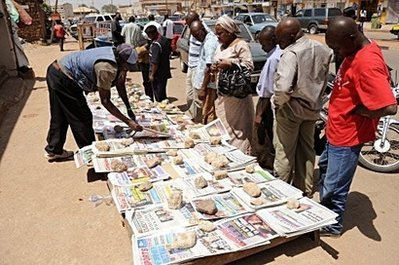
Newspaper stands can be said to represent the proverbial African Village Squares. Village squares are supposed to be places for discussion, relaxation and reflection among members of the community. However, there are two major differences between village squares and Newspaper stands. Village squares have both genders in attendance, while Newspaper stands are almost always populated by males. Thus, the opinions expressed at the News stands cannot be said to be represent those of the larger populace. The second difference is that Newspaper stands are largely active between 8 am and 12 noon while Village Squares function round the clock and come alive in the evenings. The Newspaper Ecosystem consists of the vendor, the Newspaper and the Reader. In this ecosystem, the whole is greater than the sum of its parts.
If you visited a Newspaper stand between 1990 and 2002, you would have found that the discussions revolved around Politics, Lifestyle issues and Sports. However, most of the sports stories revolved around the Super Eagles and local football teams. Discussions around English football were done by those involved in sports betting. Those were the days when lottery firms included Sports betting odds and predictions as part of the Newspaper back pages. Kanu Nwankwo‘s exploits with the Super Eagles and Arsenal FC, as well as the growing availability of Internet access/Satellite TV gradually changed the tone of discussions at newspaper stands. A visit to Newspaper stands now reveals a dichotomy among the readers. Young people gravitate towards publications such as complete sports while older folks stay with ‘serious‘ newspapers. The Sports section enjoys sustained patronage throughout the year. While the regular season is on, national competitions and Continental Cups are the sources of attraction. At the end of the season, sports newsletters keep readers busy with transfer market rumors
The expression ‘Free Readers‘ is used to describe those who hang around at Newspaper stands are deemed to read newspapers for free. I was a part of this group while attending the University of Ibadan. The central newspaper stand was a place where students, lecturers and visitors gathered to discuss various issues. You could find a student and a Professor going head to head on issues without any fear of retribution. After graduation, I became a member of this association wherever I found myself, and noticed there was a hierarchy of sorts among the members.
There are three ranks among members of the Free Readers Association: The first rank can be said to be that of general Reader. The General Reader pays a token amount – N20 or N50 and is given access to all Newspapers on the stand. The general readers are those who are new to the Association. They are expected to pay their dues. The rule is that if a customer wants to buy a copy of the newspaper in the hands of a general reader, he is expected to give it up. He is also expected to listen in on discussions and contribute without expecting to have the last word. There are others whose opinions are more highly regarded than his. Credibility at the Newspaper stand has to be established over time. As such, there are exclusions the general reader has to deal with. He is not allowed to read magazines and he is not allowed to pick up a newspaper if it is the last copy available. The reason for preventing them from touching Magazines is because of the glossy cover and paper used in most magazines. Any blemish on the glossy materials is easily noticed by customers and could prevent them from being sold. He is prevented from reading the only available copy of a newspaper because vendors always need to have at least one copy of each newspaper on display. Examples of general readers include visitors to an area, job-seekers looking for employment opportunities and sports fans.
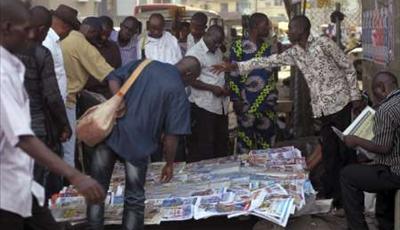
The second rank in free reader’s association could be said to be that of senior reader. A senior reader is a position to which all general readers aspire. The appointment of ‘Senior Reader’ is usually a function of time spent at the Newspaper Stand. This title is also reserved for Regular customers who stop by occasionally to discuss. They have bought newspapers in the past and may just desire to engage in occasional discussions. Senior Readers are given access to all the Newspapers on the stand as well as magazines. They are expected to be able to help moderate discussions between members. The increase in follower ship of European Football leagues has led to division among football fans. Many who openly identify themselves as fans of these clubs are prone to engaging in loud arguments. General readers help to steer these arguments in order to prevent outbreaks of violence.
The third rank in Free Reader’s Association is that of ‘Assistant Vendor‘. The assistant vendor is a general reader that is trusted by the newspaper vendor. He is able to help the vendor with sales of Newspapers. Usually, vendors have to be away from their stands in order to make sales. Vendors that are located near office environments usually make deliveries to the workers in the offices, while those present in residential areas have to sell to customers in moving vehicles. The aforementioned examples require that the Newspaper stand be manned by trusted personnel while the Vendor is momentarily away. This task is performed by ‘Assistant Vendors’, whom the vendor trusts to help give out newspapers and collect money from other readers. They usually conduct a reconciliation of accounts when the vendor returns to the stand. The job of the Assistant Vendor is usually done by students who do not have classes, retirees and those who are not in a hurry to leave the news stand. I was surprised to discover that the members of one of such associations donated money to construct benches for a news stand in my former neighbourhood, and only the members that fell into the category of Assistant Vendors and Senior Readers were allowed to sit on the benches.
There are two factors militating against the existence of Newspaper stands in our society. The first enemy is that of gentrification and rapid urbanization. There is a desire by governments to demolish any structure that isn’t made of shiny glass and fitted with air-conditioners under the guise of building mega-cities. Urban renewal has no place for traditional structures that speak of our past. In the midst of rapid gentrification in most urban centres, it’s necessary to identify the social structures which need preservation. These social structures are naturally occurring and are not like many of the contrived entities that occur with modernization. The Newspaper stand, which is usually nothing more than a crudely constructed wooden table and bench, serves a larger purpose. It delivers news of jobs to job-seekers, provides opportunities for discourse among citizens, creates a community for solitary pensioners and provides sustenance for many families.

The second enemy of Newspaper stands is Technology. We no longer have to wait for the next morning to get the latest news. Widespread availability of the Internet and an abundance of social media tools such as Whatsapp, Facebook, Twitter and Instagram are rendering newspapers irrelevant. Daily analysis of news, discussions and arguments has moved online. The truth is that the Internet provides a wide range of perspectives for many issues, and users are not bound to specific locations. The phone in your hand enables you to engage in conversations with people thousands of miles away. There are distinct advantages and a few disadvantages that come with the ability to have the world at our fingertips. One of such downsides is the lack of civility often seen online. An individual hiding under the ‘Anonymous’ tag or some unrecognisable name can make all sorts of threats, accusations and hurl abuses at well- meaning individuals. Conversations easily dissolve into name-calling and it is hard to understand the other person’s point of view. News stands are not immune to rancour, but the fact that your face is seen and your voice is heard forces some sort of civility among readers. You have to exhibit a level of decorum because you will probably run into the same individuals the day after.
My desire is not that newspaper stands will remain as they are. My hope is that they will evolve to become a place where people of all genders, religions, cultures and social status in our society can share ideas and opinions that will help enrich our humanity.